
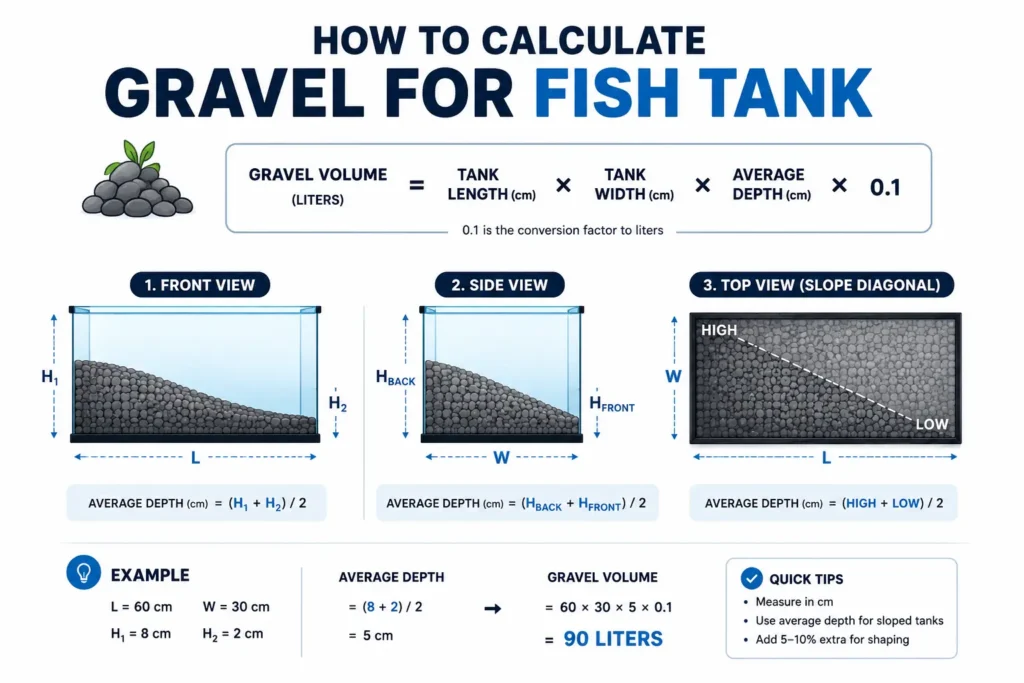
Creating a healthy and visually appealing aquarium starts with choosing the right amount of gravel. Whether you own a standard rectangular aquarium, a sloped aquascape tank, a bow-front aquarium, or a custom-designed fish tank, calculating the correct gravel quantity is essential for maintaining water quality, supporting aquatic plants, and providing a natural environment for fish. Many aquarium owners either underestimate or overestimate the amount of substrate needed, which can lead to unnecessary expenses or poor tank performance.
This guide explains how to calculate gravel for fish tanks of different shapes and angles, including practical formulas, examples, and expert recommendations.
Why Gravel Calculation Matters
Aquarium gravel is more than just decoration. It serves several important purposes:
- Provides a foundation for aquatic plants.
- Supports beneficial bacteria that help maintain water quality.
- Creates a natural habitat for fish and bottom dwellers.
- Improves the overall appearance of the aquarium.
- Helps anchor decorations and aquascaping elements.
Using too little gravel may leave plants unstable, while excessive gravel can reduce water volume and create maintenance challenges.
Basic Gravel Calculation Formula
For most aquariums, the gravel volume can be calculated using the following formula:
Gravel Volume = Length × Width × Gravel Depth
Where:
- Length = Inside length of the aquarium
- Width = Inside width of the aquarium
- Gravel Depth = Desired substrate depth
The result gives the gravel volume in cubic inches, cubic centimeters, or cubic feet, depending on the units used.
Calculating Gravel for a Standard Rectangular Fish Tank
A rectangular aquarium is the most common tank design and the easiest to calculate.
Example
Tank Dimensions:
- Length: 36 inches
- Width: 18 inches
- Desired Gravel Depth: 2.5 inches
Calculation:
Gravel Volume = 36 × 18 × 2.5
Gravel Volume = 1,620 cubic inches
This volume can then be converted into pounds or kilograms based on the gravel density.
Gravel Calculation for Front-to-Back Sloped Tanks
Many aquascapers create a sloped substrate, with the gravel deeper at the back and shallower at the front. This design adds visual depth and enhances plant growth.
Formula
Average Depth = (Front Depth + Back Depth) ÷ 2
Gravel Volume = Length × Width × Average Depth
Example
- Front Depth: 1.5 inches
- Back Depth: 4 inches
- Length: 36 inches
- Width: 18 inches
Average Depth:
(1.5 + 4) ÷ 2 = 2.75 inches
Volume:
36 × 18 × 2.75 = 1,782 cubic inches
This method provides a more accurate estimate for sloped aquariums.
Calculating Gravel for Side-to-Side Angled Fish Tanks
Some custom aquariums use a side-to-side slope rather than a front-to-back design.
Formula
Average Depth = (Left Depth + Right Depth) ÷ 2
Gravel Volume = Length × Width × Average Depth
Example
- Left Side Depth: 2 inches
- Right Side Depth: 5 inches
- Length: 30 inches
- Width: 15 inches
Average Depth:
(2 + 5) ÷ 2 = 3.5 inches
Volume:
30 × 15 × 3.5 = 1,575 cubic inches
This approach works well for artistic aquascapes and custom aquarium layouts.
Calculating Gravel for Multi-Angle Aquascape Tanks
Advanced aquascaping often includes multiple slopes, elevated sections, terraces, and rock formations.
For these tanks:
- Divide the tank into smaller sections.
- Calculate gravel volume for each section separately.
- Add all section volumes together.
Example
Section A:
36 × 8 × 1 = 288 cubic inches
Section B:
36 × 8 × 2 = 576 cubic inches
Section C:
36 × 8 × 3 = 864 cubic inches
Total Volume:
288 + 576 + 864 = 1,728 cubic inches
This method provides the highest level of accuracy for complex aquascapes.
Gravel Calculation for Cube Aquariums
Cube tanks have equal length and width dimensions.
Formula
Volume = Length × Width × Gravel Depth
Example
- Length: 24 inches
- Width: 24 inches
- Gravel Depth: 3 inches
Calculation:
24 × 24 × 3 = 1,728 cubic inches
Because cube tanks have a larger footprint relative to their volume, they often require more substrate than expected.
Gravel Calculation for Bow Front Aquariums
Bow-front tanks feature a curved front panel that increases the aquarium footprint.
Formula
Use the average width:
Average Width = (Front Width + Back Width) ÷ 2
Gravel Volume = Length × Average Width × Gravel Depth
Example
- Front Width: 18 inches
- Back Width: 14 inches
- Length: 36 inches
- Depth: 2.5 inches
Average Width:
(18 + 14) ÷ 2 = 16 inches
Volume:
36 × 16 × 2.5 = 1,440 cubic inches
This calculation provides a practical estimate for curved aquariums.
Gravel Calculation for Corner Aquariums
Corner tanks typically have a triangular footprint.
Formula
Triangle Area = (Base × Height) ÷ 2
Gravel Volume = Triangle Area × Gravel Depth
Example
- Base: 24 inches
- Height: 24 inches
- Gravel Depth: 2.5 inches
Area:
(24 × 24) ÷ 2 = 288 square inches
Volume:
288 × 2.5 = 720 cubic inches
Corner aquariums generally require less gravel than rectangular tanks of similar capacity.
Gravel Calculation for Cylindrical Fish Tanks
Round aquariums require a different approach.
Formula
Area = π × Radius²
Gravel Volume = Area × Gravel Depth
Example
- Diameter: 20 inches
- Radius: 10 inches
- Gravel Depth: 2.5 inches
Area:
3.1416 × 10² = 314.16 square inches
Volume:
314.16 × 2.5 = 785.4 cubic inches
This method works for all circular aquariums.
Recommended Gravel Depth
The ideal gravel depth depends on the aquarium type:
Freshwater Community Tanks
- 2 to 3 inches
Planted Aquariums
- 3 to 4 inches
Aquascaping Layouts
- 2 to 6 inches, depending on slope design
Cichlid Aquariums
- 1 to 2 inches
Shrimp Tanks
- 2 to 3 inches
Maintaining proper substrate depth promotes healthy root development and biological filtration.
Converting Gravel Volume to Weight
Most aquarium gravel weighs approximately:
- 1 cubic inch = 0.045–0.055 pounds
A practical estimate:
Gravel Weight (lbs) = Volume × 0.05
Example:
1,620 cubic inches × 0.05
= 81 pounds of gravel
Always purchase 10–15% extra gravel to account for leveling and aquascaping adjustments.
Common Gravel Calculation Mistakes
Many aquarium owners make these mistakes:
- Ignoring tank shape variations.
- Forgetting to account for sloped substrates.
- Measuring external rather than internal dimensions.
- Buying gravel based only on tank gallon size.
- Not allowing extra substrate for decorations and plants.
Avoiding these errors helps ensure a more accurate calculation.
Final Thoughts
Calculating gravel for a fish tank becomes simple when you understand the tank’s shape, dimensions, and desired substrate depth. Whether you have a rectangular aquarium, cube tank, bow front design, corner aquarium, cylindrical fish tank, or a professional aquascape with multiple angles, using the correct formula ensures you purchase the right amount of gravel for your setup.
A properly calculated substrate layer improves plant growth, enhances biological filtration, supports aquatic life, and creates a visually stunning aquarium. By measuring carefully and accounting for slopes, curves, and custom layouts, you can achieve both functional and aesthetic success in any aquarium project.